
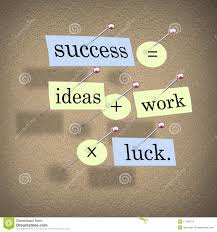
Absolute Success is Luck. Relative Success is Hard Work.
Topic: Absolute Success is Luck. Relative Success is Hard Work.
Key Words: Success and Luck, success principles, hard work and success
Headings: The Power of Hard Work, Luck or Hard Work? Absolute Success vs. Relative Success.

Introduction
In 1997, Warren Buffett, the famous investor, and multi-billionaire proposed a thought experiment.
“Imagine that it is 24 hours before you are going to be born,” he said, “and a genie comes to you.” “The genie says you can determine the rules of the society you are about to enter and you can design anything you want. You get to design the social rules, the economic rules, the governmental rules. And those rules are going to prevail for your lifetime and your children’s lifetime and your grandchildren’s lifetime.”
“But there is a catch,” he said.
“You don’t know whether you’re going to be born rich or poor, male or female, infirm or able-bodied, in the United States or Afghanistan. All you know is that you get to take one ball out of a barrel with 5.8 billion balls in it. And that’s you.” “In other words,” Buffett continues, “you’re going to participate in what I call the Ovarian Lottery. And that is the most important thing that’s ever going to happen to you in your life. It’s going to determine way more than what school you go to, how hard you work, all kinds of things.” Buffett has long been a proponent for the role of luck in success. In his 2014 Annual Letter, he wrote, “Through dumb luck, [my business partner] Charlie and I were born in the United States, and we are forever grateful for the staggering advantages this accident of birth has given us.” When explained in this way, it seems hard to deny the importance of luck, randomness, and good fortune in life. And indeed, these factors play a critical role. But let’s consider the second story.
In 1969, during the fourteenth year of the Vietnam War, a Chinese scientist named Tu Youyou was appointed the head of a secret research group in Beijing. The unit was known only by its code name: Project 523.
China was an ally with Vietnam, and Project 523 had been created to develop antimalarial medications that could be administered to the soldiers. The disease had become a huge problem. Just as many Vietnamese soldiers were dying from malaria in the jungle as were dying in battle.
Tu began her work by looking for clues anywhere she could find them. She read manuals about old folk remedies. She searched through ancient texts that were hundreds or thousands of years old. She traveled to remote regions in search of plants that might contain a cure.
After months of work, her team had collected over 600 plants and created a list of almost 2,000 possible remedies. Slowly and methodically, Tu narrowed the list of potential medications down to 380 and tested them one-by-one on lab mice.
“This was the most challenging stage of the project,” she said. “It was a very laborious and tedious job, in particular when you faced one failure after another.” Hundreds of tests were run. Most of them yielded nothing. But one test—an extract from the sweet wormwood plant known as—seemed promising. Tu was excited by the possibility, but despite her best efforts, the plant would only occasionally produce a powerful antimalarial medication. It wouldn’t always work.
Her team had already been at work for two years, but she decided they needed to start again from the beginning. Tu reviewed every test and re-read each book, searching for a clue about something she missed. Then, magically, she stumbled on a single sentence in The Handbook of Prescriptions for Emergencies, an ancient Chinese text written over 1,500 years ago.
The issue was heated. If the temperature was too high during the extraction process, the active ingredient in the sweet wormwood plant would be destroyed. Tu redesigned the experiment using solvents with a lower boiling point and, finally, she had an antimalarial medication that worked 100 percent of the time.
It was a huge breakthrough, but the real work was just beginning.
The Power of Hard Work
With a proven medication in hand, it was now time for human trials. Unfortunately, there were no centers in China performing trials for new drugs at the time. And due to the secrecy of the project, going to a facility outside of the country was out of the question.
They had reached a dead end.
That’s when Tu volunteered to be the first human subject to try the medication. In one of the boldest moves in the history of medical science, she and two other members of Project 523 infected themselves with malaria and received the first doses of their new drug.
It worked.
However, despite her discovery of a breakthrough medication and her willingness to put her own life on the line, Tu was prevented from sharing her findings with the outside world. The Chinese government had strict rules that blocked the publishing of any scientific information.
She was undeterred. Tu continued her research, eventually learning the chemical structure of the drug—a compound officially known as artemisinin—and going on to develop a second antimalarial medication as well.
It was not until 1978, almost a decade after she began and three years after the Vietnam War had ended, that Tu’s work was finally released to the outside world. She would have to wait until the year 2000 before the World Health Organization would recommend the treatment as a defense against malaria.
Today, the artemisinin treatment has been administered over 1 billion times to malaria patients. It is believed to have saved millions of lives. Tu Youyou is the first female Chinese citizen to receive a Nobel Prize, and the first Chinese person to receive the Lasker Award for major contributions to medical science.
Luck or Hard Work?
Tu Youyou was not fabulously lucky. My favorite fact about her is that she has no postgraduate degree, no research experience abroad, and no membership in any of the Chinese national academies—a feat that has earned her the nickname “The Professor of the Three No’s”. But damn was she a hard worker. Persistent. Diligent. Driven. For decades she didn’t give up and she helped save millions of lives as a result. Her story is a brilliant example of how important hard work can be in achieving success.
Just a minute ago, it seemed reasonable that the Ovarian Lottery determined most of your success in life, but the idea that hard work matters feels just as reasonable. When you work hard you typically get better results than you would with less effort. While we can’t deny the importance of luck, everyone seems to have this sense that hard work really does make a difference.
So what it is? What determines success? Hard work or good fortune? Effort or randomness? I think we all understand both factors play a role, but I’d like to give you a better answer than “It depends.”
Here are two ways I look at the issue.
Absolute Success vs. Relative Success
One way to answer this question is to say: Luck matters more in an absolute sense and hard work matters more in a relative sense.
The absolute view considers your level of success compared to everyone else. What makes someone the best in the world in a particular domain? When viewed at this level, success is nearly always attributable to luck. Even if you make a good initial choice—like Bill Gates choosing to start a computer company—you can’t understand all of the factors that cause world-class outcomes.
As a general rule, the wilder the success, the more extreme and unlikely the circumstances that caused it. It’s often a combination of the right genes, the right connections, the right timing, and a thousand other influences that nobody is wise enough to predict.
As a general rule, the wilder the success, the more extreme and unlikely the circumstances that caused it.
Then there is the relative view, which considers your level of success compared to those similar to you. What about the millions of people who received similar levels of education, grew up in similar neighborhoods, or were born with similar levels of genetic talent? These people aren’t achieving the same results. The more local the comparison becomes, the more success is determined by hard work. When you compare yourself to those who have experienced similar levels of luck, the difference is in your habits and choices.
Absolute success is luck. Relative success is choices and habits.
Both Stories are True
Sometimes people have trouble simultaneously holding both of these insights. There is a tendency to discuss outcomes in either a global sense or a local sense.
The absolute view is more global. What explains the difference between a wealthy person born in America and someone born into extreme poverty and living on less than $1 per day? When discussing success from this angle, people say things like, “How can you not see your privilege? Don’t you realize how much has been handed to you?”
The relative view is more local. What explains the difference in results between you and everyone who went to the same school or grew up in the same neighborhood or worked for the same company? When considering success from a local viewpoint, people say things like, “Are you kidding me? Do you know hard I worked? Do you understand the choices and sacrifices I made that others didn’t? Dismissing my success as luck devalues the hard work I put in. If my success is due to luck or my environment, then how come my neighbors or classmates or coworkers didn’t achieve the same thing?”
Both stories are true. It just depends on what lens you are viewing life through.
The Slope of Success
There is another way to examine the balance between luck and hard work, which is to consider how success is influenced across time.
Imagine you can map success on a graph. Success is measured on the Y-axis. Time is measured on the X-axis. And when you are born, the ball you pluck out of Buffett’s Ovarian Lottery determines the y-intercept. Those who are born lucky start higher on the graph. Those who are born into tougher circumstances start lower.
Here’s the key: You can only control the slope of your success, not your initial position.
In Atomic Habits, I wrote, “It doesn’t matter how successful or unsuccessful you are right now. What matters is whether your habits are putting you on the path toward success. You should be far more concerned with your current trajectory than with your current results.”
You can only control the slope of your success, not your initial position.
With a positive slope and enough time and effort, you may even be able to regain the ground that was lost due to bad luck. I thought this quote summarized it well: “The more time passes from the start of a race, the less the head-start others got matters.” This is not always true, of course. A severe illness can wipe out your health. A collapsing pension fund can ruin your retirement savings. Similarly, sometimes luck delivers a sustained advantage (or disadvantage). In fact, one study found that, if success is measured by wealth, then the most successful people are almost certainly those with moderate talent and remarkable luck. In any case, it is impossible to divorce the two. They both matter and hard work often plays a more important role as time goes on.
This is true not only for overcoming bad luck but also for capitalizing on good luck. Bill Gates might have been incredibly fortunate to start Microsoft at the right time in history, but without decades of hard work, the opportunity would have been wasted. Time erodes every advantage. At some point, good luck requires hard work if success is to be sustained.
How to Get Luck on Your Side
By definition, luck is out of your control. Even so, it is useful to understand the role it plays and how it works so you can prepare for when fortune (or misfortune) comes your way. In the end, we cannot control our luck—good or bad—but we can control our effort and preparation. Luck smiles on us the most
Comfort Zone
Topic: Comfort Zone
Keywords
Comfort zone psychology Personal comfort zone comfort zone meaning
Comfort zone activities outside the comfort zone
Main points
7 steps of the comfort zone
How to beat your comfort zone
Introduction
Article
Introduction
A comfort zone is a psychological state in which things feel familiar to a person and they are at ease and in control of their environment, experiencing low levels of anxiety and stress. In this zone, a steady level of performance is possible…
7 Benefits from Stepping Outside Your Comfort Zone
“Life begins at the end of your comfort zone1. Opportunity to grow: Challenging yourself can help you reach your peak performance level. You can’t expect to evolve and reach new heights if you only stick to your normal habits and routine lifestyle. Learning new skills and lessons will help you throughout your life. 2. Learn about yourself: Taking risks will help you grow as an individual and will teach you about your interests, passions, talents, strengths, and weaknesses. Every time you accomplish something you didn’t think you were capable of, you become more confident, knowledgeable and skilled. 3. Expanding yourself and your creativity: When you try something new, you may find a new hobby or talent that you didn’t know that you had. New and challenging situations require you to find your own creativity in order to reach a solution.
4. Increase your self-confidence: Tackling the unknown and proving to yourself you can push past your boundaries and limiting self-beliefs builds your self-confidence and self-esteem. Insecurity loves to feed on your habit of not trying. If you stop thinking and start acting, you will realize what’s possible. 5. Learn to deal with challenges: Life is unpredictable and it’s important to have the skills and confidence to face them head-on. Knowing that you were able to overcome something you thought was insurmountable will build your confidence and reinforce your independence of who you are. c 6. Life becomes lively: When your life stops being a scene from the movie Groundhog Day, everything shows up different. Life becomes more interesting and worth living. Risks may look like adventures and obstacles could look like opportunities. When you are happier on the inside, your appreciation for what’s around you increases. Surprise yourself daily. 7. Build new relationships: Trying something new helps you to meet all sorts of new people you may not have met otherwise staying in your comfort zone. In order to have good relationships with others, you must have a good relationship with yourself. If you are not happy with who you are or what you do, it will be challenging to value the good qualities of the people around you. Stepping out of your comfort zone, discovering who you are and overcoming yours fears will ultimately result in better relationships with others. Drama decreases as your confidence and life’s perspective increases.
1. it’s keeping you from growth
2. it’s keeping you from trying new things 3. it’s conditioning you to settle
How to beat your comfort zone
Despite the power that your comfort zone holds over you, with the right effort and some patience, it’s quite easy to develop the habit to step outside of it. You just need to know the right way to do it.
When I was younger, I had this old pair of shoes I’d wear from time to time. They were completely tattered, with one of my big toes occasionally sticking out, and wearing them attracted the inevitable glances and funny looks. But I didn’t do it as a fashion statement. I did it because it made me feel uncomfortable. The more I wore them, the more I got comfortable with being uncomfortable.
Why is this important?
The trick to beating your comfort zone, to making it a habit of stepping outside of yourself and growing consistently, is to lower your resistance to doing the task
Health & Fitness
Thanks for joining me


Is physical activity or physical fitness more important in defining health benefits?
PURPOSE:
We addressed three questions:
1) Is there a dose-response relation between physical activity and health?
2) Is there a dose-response relation between cardiorespiratory fitness and health?
3) If both activity and fitness have a dose-response relation to health, is it possible to determine which exposure is more important?
METHODS:
We identified articles by (restricted from 1/1/90 to 8/25/00) using keywords related to physical activity, physical fitness, and health. An author scanned titles and abstracts of 9831 identified articles. We included for thorough review articles that included three or more categories of activity or fitness and a health outcome and excluded articles on clinical trials, review papers, comments, letters, case reports, and nonhuman studies. We used an evidence-based approach to evaluate the quality of the published data. RESULTS: We summarized results from 67 articles meeting final selection criteria. There is good consensus across studies with most showing an inverse dose-response gradient across both activity and fitness categories for morbidity from coronary heart disease (CHD), stroke, cardiovascular disease (CVD), or cancer; and for CVD, cancer, or all-cause mortality. CONCLUSIONS: All studies reviewed were prospective observational investigations; thus, conclusions are based on Evidence Category C. 1) There is a consistent gradient across activity groups indicating greater longevity and reduced risk of CHD, CVD, stroke, and colon cancer in more active individuals. 2) Studies are compelling in the consistency and steepness of the gradient across fitness groups. Most show a curvilinear gradient, with a steep slope at low levels of fitness and an asymptote in the upper part of the fitness distribution. 3) It is not possible to conclude whether activity or fitness is more important for health. Future studies should define more precisely the shape of the dose-response gradient across activity or fitness groups, evaluate the role of musculoskeletal fitness, and investigate additional health outcomes.

PERFORMANCE PHENOTYPES. A total of 10 articles from case-control studies were published in the polymorphism, which consists of the presence/absence of a 9-base pair (bp) repeat sequence in exon 1, were investigated in ironman triathlon The fast finishers of the triathlon showed a higher number of j9/j9 genotypes compared with the controls. The nitric oxide genotypes were also investigated for association in this athlete group, and a significant linear trend of increasing frequency of the genotypes among turtles of the triathlon finishers from fastest to slowest was observed. The same linear trend was observed for the combined +9/+9 and GG multivariate genotype groups. In addition, the combined
 healthcareand.fitness.blog